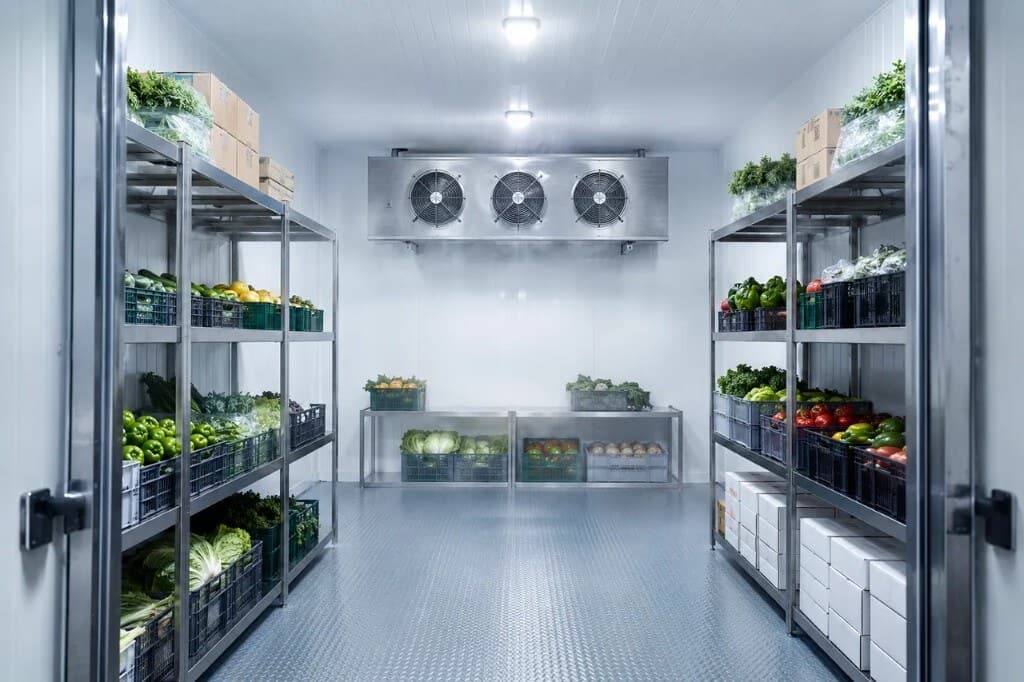
These rooms differ by purpose, not only controller setpoint. A chiller holds products above freezing, a storage freezer maintains already-frozen goods, and a blast freezer is designed to remove product heat through the freezing zone within a defined process.
Comparison
| Topic | Chill room | Storage freezer | Blast freezer |
|---|---|---|---|
| Typical air range | 0 to 10°C | -18 to -25°C | About -30 to -40°C or project specific |
| Objective | Chilled holding or moderate cooling | Maintain frozen products | Reach a defined core temperature in time |
| Product load | Usually moderate | Preferably pre-frozen | High during each batch |
| Airflow | Balanced against moisture loss | Even room circulation | Velocity and path are process-critical |
| Acceptance | Air and product condition | Stable storage range | Core temperature, mass, and elapsed time |
Actual values depend on the product, packaging, food-safety plan, and applicable standards.
Why a storage freezer is not always a blast freezer
A storage unit may be sized mainly for wall transmission and door openings on the assumption that goods arrive frozen. Warm product introduces sensible and latent loads that can overwhelm it. Blast design considers batch mass, initial and final core temperature, target time, package geometry, and airflow resistance.
Conversely, operating a chill room too cold can cause chilling injury in sensitive produce and excessive coil frost. Product requirements must lead the decision.
Questions to answer
- Does the product arrive fresh, chilled, or frozen?
- What mass, piece size, packaging, and stacking pattern enter each cycle?
- What core temperature must be reached, and by when?
- Is the next step storage, transport, or processing?
- What moisture and texture change is acceptable?
- What defrost, sanitation, and redundancy arrangement is required?
Measuring performance
Air temperature reacts faster than the product. A valid pull-down test records starting mass, loading pattern, calibrated probe locations, initial and final core temperatures, and elapsed time. Probes should not sit in an air void or against metal.
Airflow and operation
Keep evaporator intake and discharge paths clear, prevent pallet stacks from short-circuiting air, and manage door-open time. Strip curtains may reduce some infiltration but do not replace operating discipline. Blast racks, trays, spacing, and coil selection should be designed together because changing the load arrangement can materially change freezing time.
Plan the project with Intercooling
This article is an initial planning guide. Final temperature, equipment capacity, and budget depend on the product, loading pattern, site, and operating method. Explore our services and cold-room systems, review representative projects, or contact the engineering team to arrange a site survey. For temperature selection, also read chill rooms, freezers, and blast freezing compared.