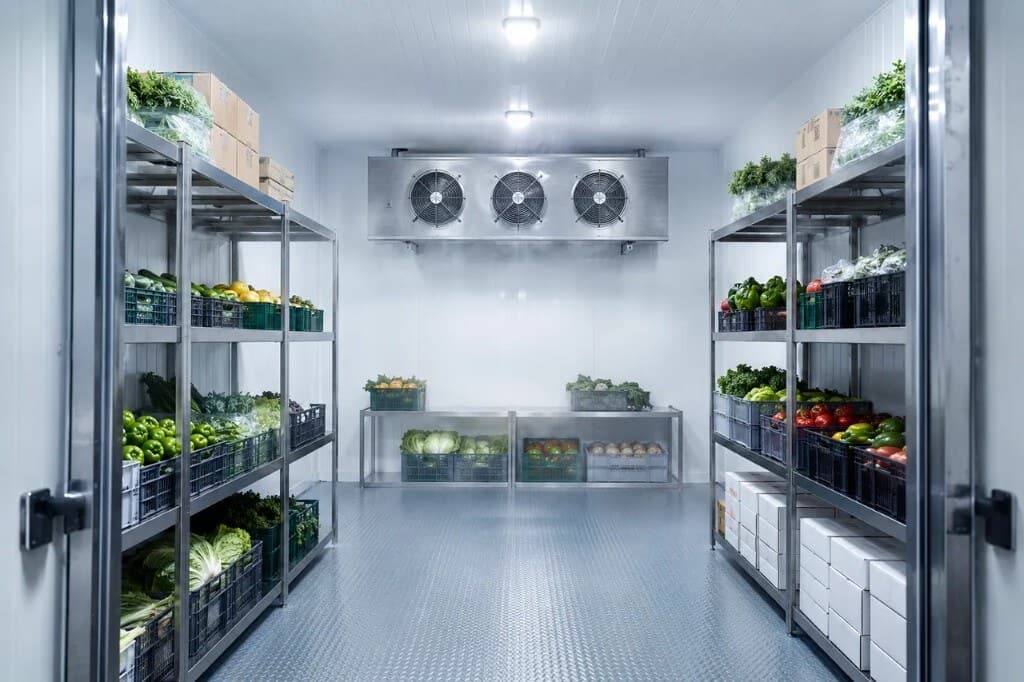
Fruit and vegetables continue to respire after harvest, producing heat, losing moisture, and responding to ethylene. Refrigeration can slow these processes when conditions suit the commodity, but it cannot restore quality already lost. Shelf life should not be promised without considering cultivar, maturity, injury, sanitation, and the full cold chain.
Indicative conditions
| Example group | Temperature guide | RH guide | Main caution |
|---|---|---|---|
| Many leafy vegetables | 0-5°C | 90-95% | Rapid wilting and airflow moisture loss |
| Broccoli and cabbage | 0-5°C | 90-95% | Prompt cooling and sanitation |
| Tomatoes by maturity | 10-15°C | 85-95% | Chilling injury if held too cold |
| Green bananas | 13-15°C | 85-95% | Cold and ethylene sensitivity |
| Mangoes | About 10-13°C | 85-95% | Cultivar and maturity matter |
| Grapes | 0-2°C | 90-95% | Condensation and mould control |
| Dry onions | 0-5°C or specific regime | 65-75% | High RH can encourage sprouting or mould |
These are starting points. Confirm against commodity guidance, buyer specifications, and trials. Different products may be incompatible in one room.
Field heat and precooling
Freshly harvested produce can arrive much warmer than the room. A large simultaneous intake creates a higher load than steady storage. Forced-air, hydro, or another precooling method may be appropriate depending on the product and package. Do not assume a holding room can remove a large field load quickly without calculation.
Design inputs include daily mass, entry temperature, receiving hours, and dispatch deadline. Ventilated cartons must align to form air paths; tight wrapping or dense pallet layouts can leave warm cores.
Humidity, airflow, and condensation
High RH limits wilting, but wet surfaces and condensation can increase decay risk. Coil size, evaporating temperature difference, compressor cycling, and defrost all affect room humidity. Misting requires water-quality and hygiene assessment.
Avoid concentrated jets on moisture-sensitive products while maintaining enough circulation for uniform conditions. During validation, use calibrated loggers at several representative points, away from doors and direct discharge.
Ethylene and compatibility
Some fruit generates substantial ethylene while certain vegetables are highly sensitive to it. Separating commodities by temperature, RH, odour, and ethylene compatibility is often safer than mixed storage. Ventilation or ethylene treatment should be sized from the actual load and generation rate.
Hygiene and records
Separate clean product and waste routes, manage crate cleaning and drainage, and service evaporators without contaminating exposed food. Record room air, sample product temperatures, door events, and lot details. This evidence is more useful than simply lowering the setpoint whenever a quality issue appears.
Plan the project with Intercooling
This article is an initial planning guide. Final temperature, equipment capacity, and budget depend on the product, loading pattern, site, and operating method. Explore our services and cold-room systems, review representative projects, or contact the engineering team to arrange a site survey. For temperature selection, also read chill rooms, freezers, and blast freezing compared.