Refrigeration architecture should follow temperature, load profile, pipework, refrigerant safety, service capability, and outage consequence. A more complex system may benefit one duty while adding controls and maintenance requirements.
Direct expansion
In DX systems, refrigerant expands directly into the evaporator and returns as vapour to the compressor. The arrangement is familiar and scales from small rooms to multi-evaporator systems when properly engineered. Design concerns include superheat, oil return, pressure drop, pipe length, and charge.
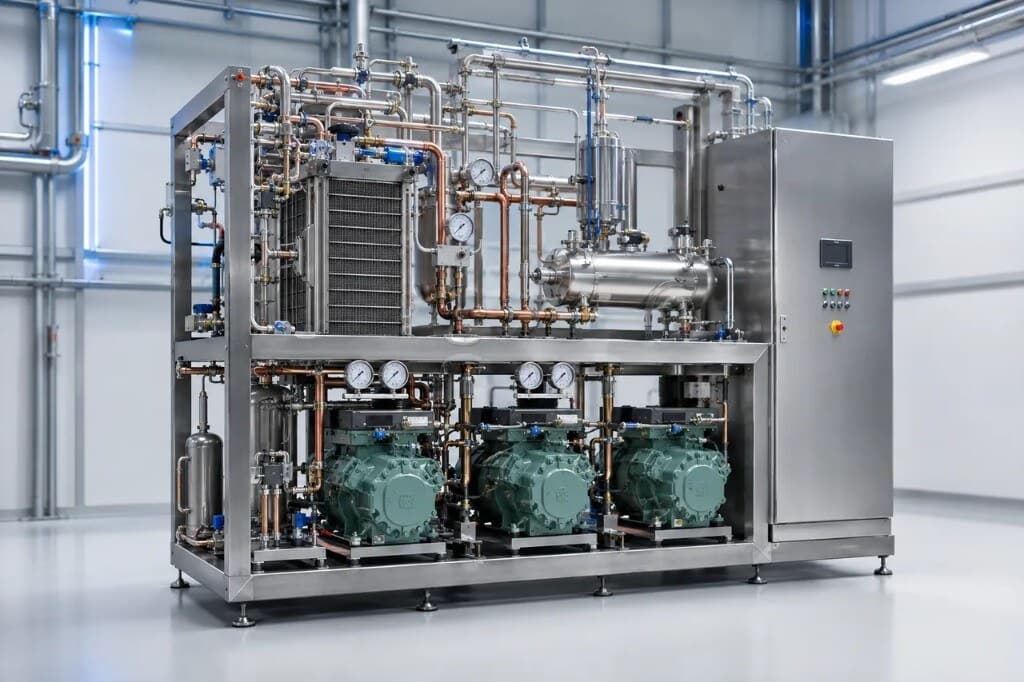
Multiple rooms may use individual condensing units or a shared rack. A rack can stage capacity effectively, but a common failure may affect several rooms. Isolation and redundancy therefore need explicit review.
Cascade refrigeration
A cascade uses two circuits connected through a heat exchanger. The low-temperature circuit rejects heat into the higher-temperature circuit. It can suit very-low-temperature duties where a single compression stage is unsuitable. Refrigerant choice and benefit depend on design conditions.
Cascade systems add compressors, controls, protective devices, and start-stop sequencing. Interstage temperature and capacity must balance, so the operational need should justify the complexity.
Pump-down control
Pump-down is a control sequence, not a separate refrigeration cycle. When cooling demand ends, the liquid solenoid closes and the compressor draws low-side refrigerant toward the receiver until a low-pressure control stops it. Correctly applied, this can reduce off-cycle migration and start-up floodback risk.
Pressure settings must suit refrigerant and duty, receiver volume must be adequate, and leaking valves must not cause repeated cycling.
Selection matrix
| Criterion | Question |
|---|---|
| Conditions | What are evaporating, condensing, and hourly load profiles? |
| Continuity | How many rooms does one failure affect? |
| Refrigerant | What safety, legal, charge, and supply issues apply? |
| Energy | How does the system perform at real part load and ambient? |
| Service | Are skills, tools, access, and parts available? |
| Controls | Are alarms, trends, interlocks, and safe overrides defined? |
Documentation and safety
Require P&IDs, valve schedules, service points, control sequences, and alarm cause-and-effect. Document design pressures, leak testing, ventilation, and detection appropriate to the refrigerant. Protective devices should never be bypassed simply to keep equipment running. Final design must meet the regulations and standards applicable to the site.
Plan the project with Intercooling
This article is an initial planning guide. Final temperature, equipment capacity, and budget depend on the product, loading pattern, site, and operating method. Explore our services and cold-room systems, review representative projects, or contact the engineering team to arrange a site survey. For temperature selection, also read chill rooms, freezers, and blast freezing compared.