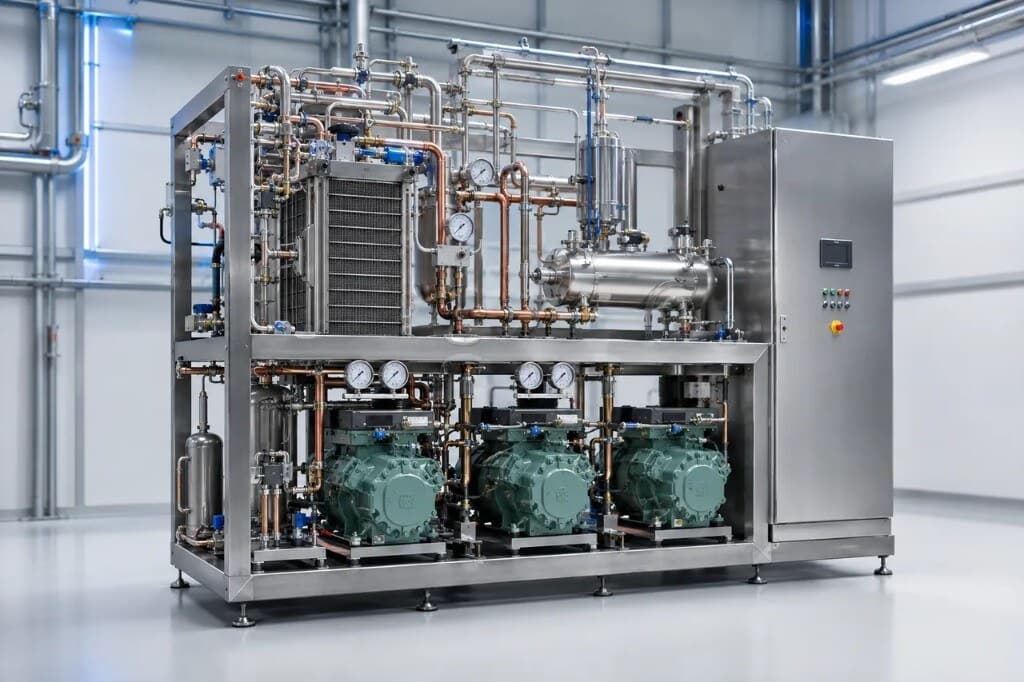
Cold-room performance depends on the complete circuit. A larger compressor cannot compensate for an evaporator with blocked airflow, and precise controls cannot correct a badly located sensor. Selection must consider capacity at actual conditions, control, safety, and serviceability.
Main components
| Component | Function | Selection focus |
|---|---|---|
| Compressor | Circulates and compresses vapour | Envelope, oil management, protection |
| Condenser | Rejects heat | Inlet air, cleaning access, noise, ambient |
| Evaporator | Absorbs room heat | Duty, TD, fin spacing, airflow, defrost |
| Expansion valve | Meters refrigerant | Superheat, turndown, sensor installation |
| Receiver/accumulator | Manages circuit charge | Volume, layout, pressure protection |
| Controller | Sequences and alarms | Fail-safe logic, logging, permissions |
Why fin spacing matters
Close fins provide more exchange area in a compact casing but can block quickly with frost or debris. Wider spacing can suit some low-temperature or humid duties but may require a larger coil. There is no universally best pitch. Evaluate evaporating condition, humidity ingress, defrost frequency, and cleaning.
The temperature difference between room air and coil affects both capacity and moisture removal. A high TD may dry air more; a lower TD often requires more coil surface. Product quality, footprint, and cost must be balanced.
Fans, defrost, and controls
Fan throw, rack resistance, room geometry, and service clearance all matter. EC fans or speed control may reduce power at part load, but minimum circulation must remain adequate.
Off-cycle, electric, hot-gas, and other defrost methods have different applications. Time-only control can over- or under-defrost. Appropriate termination, drip time, and fan delay help prevent heat and water from returning to the room.
Use separate control and monitoring sensors where risk justifies it. Pressure, overload, phase, and relief protection must suit the circuit. Alarms should identify an actionable cause.
Design for maintenance
Provide room to open coil trays, remove motors, clean condensers, and reach valves safely. Label circuits and equipment. Handover should include manuals, wiring, P&IDs, parameter lists, and critical spare recommendations. Accessible equipment is more likely to receive the planned inspection it needs.
Plan the project with Intercooling
This article is an initial planning guide. Final temperature, equipment capacity, and budget depend on the product, loading pattern, site, and operating method. Explore our services and cold-room systems, review representative projects, or contact the engineering team to arrange a site survey. For temperature selection, also read chill rooms, freezers, and blast freezing compared.